← Blog · guides
Click-to-WhatsApp Ads: Complete Guide for Indian Businesses
How Click-to-WhatsApp Ads work, what they cost, creative best practices, and the metrics that actually predict conversions for Indian D2C and SMB advertisers.
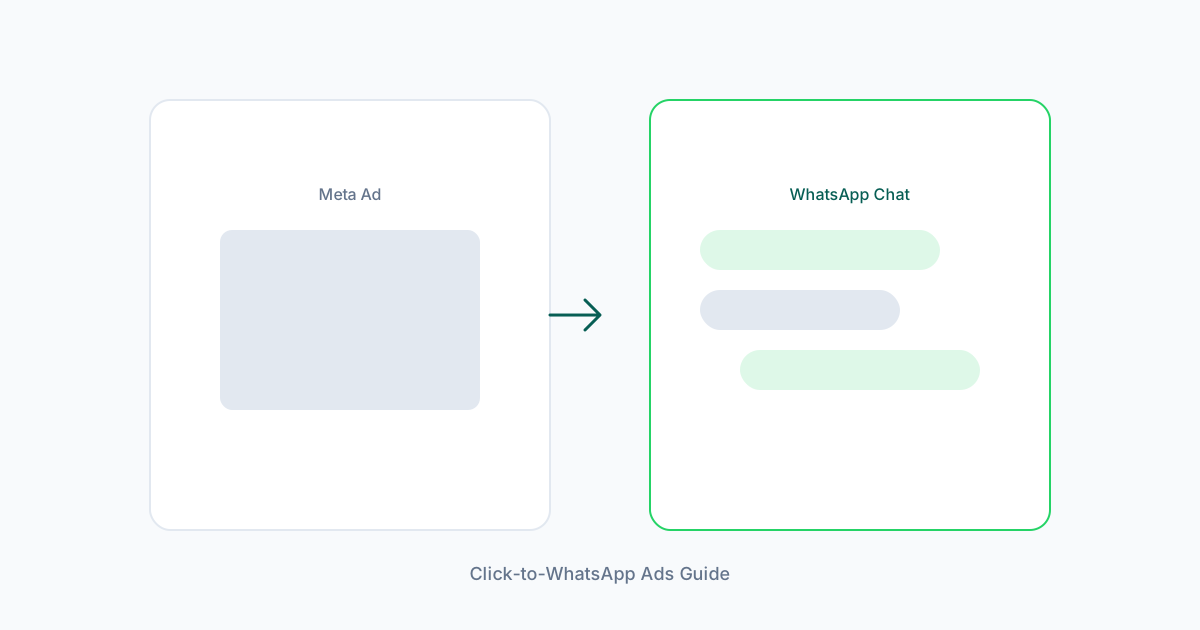
Click-to-WhatsApp Ads (CTWA) are Facebook and Instagram ads with a WhatsApp call-to-action instead of a “Learn More” button that takes users to a landing page. The user taps the ad, WhatsApp opens, and they land in a conversation with your business — no website, no form, no page-load wait.
For Indian D2C brands, edtech, real estate, and any business where the next step is a human conversation, CTWA has become one of the highest-ROI ad formats in Meta’s catalog. This guide covers setup, costs, creatives, and the metrics that predict conversions.
What Click-to-WhatsApp Ads actually are
A CTWA campaign is a normal Facebook / Instagram ad campaign with the destination set to WhatsApp. Instead of routing clicks to a landing page, Meta opens WhatsApp on the user’s device, pre-fills your business chat, and (optionally) pre-fills a starter message.
The user can edit the starter message or just hit send. The conversation lands in your BSP’s shared inbox tagged with the source campaign.
What this means in practice:
- Conversion path is one tap: ad → WhatsApp message → reply from your team.
- You skip the landing-page conversion-rate drop (typically 60–80% of clicks abandon a typical landing page).
- The lead has already chosen a comfortable channel (WhatsApp).
Why CTWA outperforms link-out ads for Indian SMBs
A few reasons specific to Indian context:
- WhatsApp penetration. Nearly every Indian smartphone user has WhatsApp. Compare to “click this link to a landing page on a domain you’ve never heard of” — much higher trust friction.
- Low-data-cost format. WhatsApp works on weak connections. Many Indian users on 4G in Tier-2/3 cities will tap a WhatsApp CTA where they’d bail on a heavy landing page.
- Hindi/regional comfort. Indian customers feel comfortable messaging in Hindi, Tamil, Telugu, etc. on WhatsApp; they often abandon English-only landing pages.
- Direct human conversation. Many SMB sales — real estate, education, healthcare consultations, custom products — actually need a human conversation to close. CTWA gets to that conversation immediately.
That said, CTWA isn’t a magic wand. It works when the next step is a conversation. For self-serve flows (e.g. “buy this t-shirt from inventory”) a checkout-page ad usually beats a CTWA ad on conversion-cost.
How the flow works end to end
User scrolls Facebook/Instagram
   ↓
Sees your CTWA ad
   ↓
Taps "Send Message" (or your CTA label)
   ↓
WhatsApp opens with your business chat,
prefilled starter message visible
   ↓
User edits (or doesn't) and sends
   ↓
Message lands in your BSP inbox
(tagged with source ad / campaign)
   ↓
Your team replies
   ↓
Lead progresses through your funnel
The clean handoff between ad and conversation is the magic. Two tools talk to each other:
- Meta Ads Manager — handles the ad creative, audience, budget.
- Your BSP (Flowgento) — handles the conversation, attribution tagging, follow-up.
Meta passes the campaign source to the BSP via the conversation entry payload. The BSP tags the conversation accordingly so you can see which ads drove which conversations and ultimately which conversions.
What it actually costs
CTWA costs sit in three places:
1. Meta ad spend
The CPC (cost per click) for CTWA in India varies by industry, audience, and creative quality. As of May 2026, Indian D2C brands typically see CTWA CPCs in the ₹3–₹20 range depending on niche and audience overlap.
2. Meta’s per-conversation charge
When the user sends a message, that triggers a marketing-initiated conversation charge from Meta (unless the user’s reply qualifies as user-initiated, which has different rules). The rate is per Meta’s published India marketing-conversation pricing.
3. BSP subscription
The BSP fee is the same regardless of CTWA volume — it’s not per-message. With Flowgento, ₹499/mo Starter handles CTWA inbound at any reasonable SMB volume without extra fees.
Total cost example for a typical Indian D2C brand:
- 1,000 ad clicks at ₹8 average CPC = ₹8,000 in Meta ad spend
- 600 actually open WhatsApp (typical 60% click-to-message conversion) = 600 marketing conversations = Meta rates apply per published India pricing
- BSP: ₹499/mo (Flowgento Starter)
- Plus your team’s time to respond
The CTWA-CPC-vs-link-out-CPC trade is usually favourable for industries where conversation is the next step.
Setup checklist (your role vs Meta’s vs the BSP’s)
Setup involves three parties. Here’s who does what:
You / your team:
- Create the ad creative (image, video, copy).
- Set targeting, budget, and bidding in Ads Manager.
- Approve the starter message users see prefilled.
- Set up your inbox routing and response templates in the BSP.
Meta (no action needed from you, but they handle):
- Ad delivery via Ads Manager.
- WhatsApp opening when user taps the CTA.
- Source-campaign attribution passed to the BSP.
Your BSP (Flowgento):
- Inbox to receive the conversations.
- Auto-tagging by source campaign.
- Analytics on conversation-to-conversion.
- Follow-up automation (welcome messages, agent assignment).
Specifically in Flowgento, after you’ve set up your WhatsApp Business API connection, CTWA attribution works automatically — incoming CTWA conversations are tagged with the ad source name. No additional configuration.
Creative best practices that work in India
After looking at thousands of CTWA ads from Indian SMBs, patterns emerge:
1. Lead with the offer or hook, not the brand. “Get free home delivery on your first order — message us” beats “We’re XYZ Bakery, established 2010”. Hook first; brand context follows in the conversation.
2. Use a specific starter message. “Hi, I want to know about your Pongal collection” is far more effective than “Hi”. A specific starter message:
- Reduces drop-off (user knows what to type).
- Pre-qualifies the lead (they actually want what you sell).
- Lets your team prepare a better first response.
3. Match creative language to audience. Hindi-language ads to Hindi-speaking audiences. Regional language for Tier-2/3 cities. Single-language ads usually outperform mixed-language.
4. Show product, not lifestyle. For most Indian SMB products, “show the product clearly” beats “lifestyle aspirational shot”. Especially for fashion, food, and home goods. Use crisp product photography.
5. Test starter-message wording before scaling. Two versions: “I’m interested in [product]” vs “Tell me more about [product]”. One usually wins by 20–40%. A/B test in a small campaign before committing budget.
6. Hindi numerals where appropriate. For pricing in copy, “₹999” tends to read better than “Rs 999” for younger audiences.
The metrics that matter (and the ones that don’t)
Useful metrics:
- Conversation-to-conversion rate. Of the conversations you receive, how many close into the intended action (purchase, booking, signup)?
- Cost per conversation initiated. Total ad spend ÷ conversations received. Often a better leading indicator than CPC.
- Reply rate from your team. What % of conversations get a team reply within 30 minutes? Below 80% is usually a problem.
- Average conversation length. Long conversations (10+ messages) often indicate genuine interest. Very short conversations (1–2 messages) suggest users not actually interested.
Less useful or misleading metrics:
- CTR alone. A high CTR doesn’t matter if conversations don’t convert.
- Conversation volume. Volume without quality is noise — your team gets buried in low-intent chats.
- Vanity engagement metrics (likes, shares). WhatsApp ads optimize for conversation, not awareness; engagement on the ad itself is secondary.
Common mistakes
Mistake 1: Underestimating staffing. A successful CTWA campaign generates dozens of conversations per day. If your team isn’t ready to respond within an hour, lead quality collapses. Plan staffing before scaling ad spend.
Mistake 2: Generic auto-replies. “Thanks for your message, we’ll respond soon” is fine as a holding message. Generic auto-replies that pretend to be human (“Hi! I’m Priya. How can I help?”) break trust when the actual reply comes from someone else 8 hours later.
Mistake 3: Sending the lead back to a landing page. Once they’re in your WhatsApp inbox, keep the conversation in WhatsApp. Don’t send a link saying “see our website for prices” — it defeats the purpose of CTWA.
Mistake 4: No follow-up cadence. Most leads don’t convert in the first conversation. Define a 24h, 72h, 7-day follow-up cadence and use tags to track where each lead is.
Mistake 5: Treating CTWA as one-way. The conversation is your most valuable asset. Customers expect a real conversation, not a bot script. Be present, be human, and CTWA economics will favour you.
FAQs
Do I need a chatbot to handle CTWA volume? Not initially. For most Indian SMBs, human responses for the first 50–100 conversations a day are fine. Bots can come later for FAQ-handling once you understand the actual question patterns.
Can I run CTWA without a BSP? You need a BSP or direct Meta API integration to receive WhatsApp Business API conversations. The free WhatsApp Business app supports CTWA but at low volume and without team-inbox features.
How does Flowgento attribute CTWA? Incoming CTWA conversations get auto-tagged with the source campaign / ad set name pulled from the Meta entry payload. You can filter the inbox by source and run conversion analytics against campaigns.
What about Instagram Click-to-WhatsApp? Same flow. Instagram ads with WhatsApp CTAs route through the same Meta infrastructure. Attribution and inbox handling are identical.
Do CTWA conversations count against my Meta marketing-conversation limits? Generally yes — the first message you send back is typically a marketing-template-style message, which counts as a marketing conversation. Plan budget accordingly.
Can I retarget CTWA leads with future ads? Yes, using Meta’s audience tools. You can build a custom audience of people who messaged you and run retargeting ads. Coordinate with your privacy policy and DPDP Act 2023 obligations.
CTWA done right is one of the most efficient ad formats available to Indian SMBs in 2026. Done wrong, it’s a fast way to burn budget. The difference is mostly in conversation handling — not ad creative. Try Flowgento free and see how a clean CTWA inbox flow feels.
Try Flowgento free
The WhatsApp CRM built for Indian SMBs. No credit card, no broker markup.