← Blog · guides
WhatsApp Business API ROI — How Indian SMBs Measure Success in 2026
A clear framework for measuring WhatsApp Business API ROI as an Indian SMB — what to count, how to attribute, sample calculations for D2C, real estate, and edtech, and the metrics that lie.
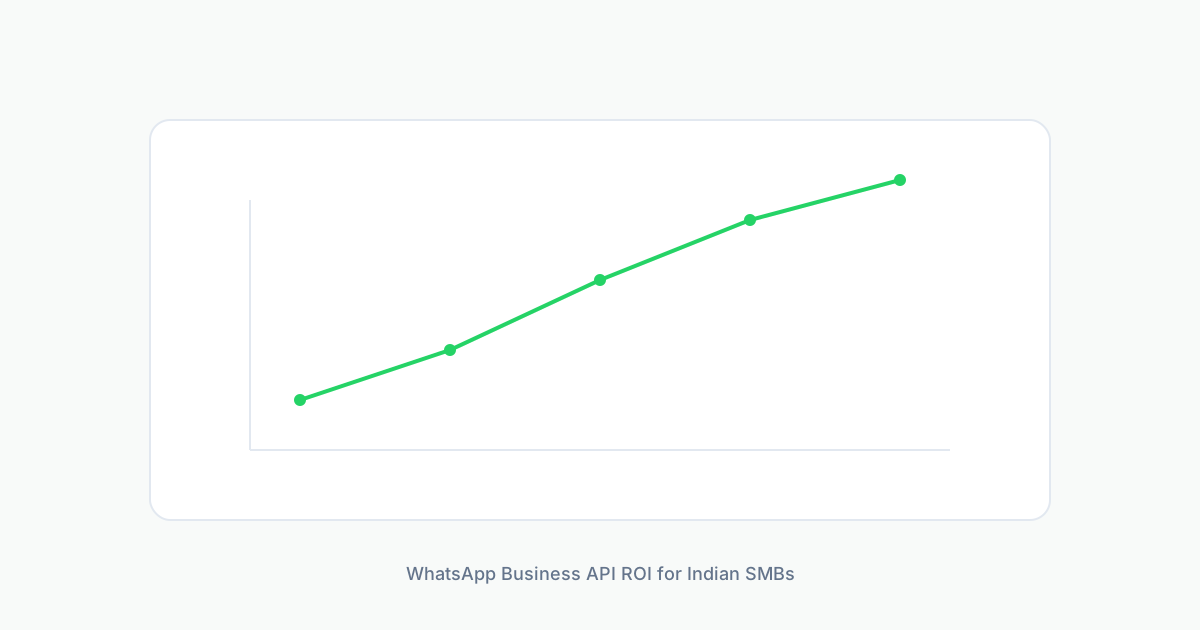
Every Indian SMB we talk to has the same first question after signing up: “how do I measure if this is actually working?” Most ROI calculations we see on WhatsApp Business API spend are wrong — usually too generous, occasionally too harsh, almost always missing categories.
This guide gives you a defensible framework, three full sample calculations (D2C, real estate, edtech), and the metrics that should never go on a board slide.
The honest ROI framework
ROI on WhatsApp Business API for an Indian SMB has three accounting layers. Compute all three before deciding whether the channel is “working”:
- Direct attributable revenue — revenue that wouldn’t have existed without WhatsApp.
- Indirect lift — revenue that exists anyway but is more likely / faster / larger because of WhatsApp.
- Cost displacement — costs you no longer incur because WhatsApp replaced an older workflow.
Then subtract the full cost stack and divide. Sounds simple; almost no SMB tracks all three layers.
What to count as benefit
The cleanest accounting splits benefits into the three layers, then attributes each to a specific WhatsApp flow.
Direct attributable revenue
- CTWA-originated orders with a clean source tag.
- Cart recovery conversions where the customer abandoned, received a WhatsApp template, then returned within the recovery window (usually 48 hours).
- Win-back / lapsed-customer broadcast purchases with a unique discount code.
- Pre-booked appointments / site visits / consultations that originated from WhatsApp.
Indirect lift
- RTO reduction from COD verification. Multiply (avoided RTO orders) × (cost saved per RTO).
- Faster lead-to-close cycles. Estimate hours saved per closure × hourly cost of the agent’s time.
- Higher repeat purchase rate from customers in your WhatsApp opted-in segment vs cold list.
- Reduced “where’s my order” support tickets thanks to proactive shipping updates.
Cost displacement
- SMS spend you no longer make because OTPs or transactional notifications moved to WhatsApp.
- Call-center minutes you save for routine inquiries that now self-serve via WhatsApp.
- Headcount cost avoided when one shared inbox replaces several agents’ personal WhatsApp numbers.
What to count as cost (everything, please)
Total WhatsApp Business API cost has more components than most SMBs realize:
- Platform / BSP subscription — your monthly Flowgento (or Wati, AiSensy, etc.) fee.
- Meta per-conversation charges — billed by Meta directly, by template category. India 2026: ~₹0.115 utility / ~₹0.78 marketing / ~₹0.16 authentication per conversation. Verify on Meta’s pricing page.
- CTWA ad spend — your Meta ads budget specifically for WhatsApp-destination campaigns.
- Setup costs — one-time integration work, template design, training. Amortize over 12–24 months.
- Operational headcount — agent time spent on WhatsApp specifically. If 1 agent spends 50% of their time on WhatsApp, count 50% of their salary.
Leaving out any of these gives a flattering but useless ROI number.
Attribution: the hardest part
For most Indian SMBs, attribution-by-source is what separates an honest ROI calculation from a fantasy one.
What works
- Tag every conversation with its origin. CTWA, organic website widget, QR code, manual outreach, broadcast response. Your BSP should do this automatically — Flowgento does.
- Use unique discount codes per source. CTWA-only code, broadcast-only code, etc. The code becomes your attribution key in the order data.
- Cohort-track WhatsApp opt-ins vs non-opt-ins. Their relative purchase frequency over 90 days gives you the indirect-lift number.
- Maintain a “first WhatsApp touch” timestamp per customer. Any purchase within N days of first WhatsApp touch is attributable; beyond N is not (pick N=30 or 60 for your category).
What doesn’t work
- Asking customers “how did you find us?” — last-touch bias, recall failure, 25–40% wrong-attribution rate.
- Trusting Google Analytics “WhatsApp” referrals — WhatsApp doesn’t send a referrer header reliably; the data is incomplete.
- Counting every conversation as influenced. Conversations happen for many reasons; not all touched-by-WhatsApp customers were converted by WhatsApp.
Sample calculation: D2C brand
Setup: Mid-size Indian D2C skincare brand on Flowgento Growth plan. AOV ₹1,800. ~3,000 orders/month total.
Benefits (monthly)
| Source | Volume | Revenue | Notes |
|---|---|---|---|
| CTWA-originated orders | 180 | ₹3,24,000 | Source-tagged |
| Cart recovery conversions | 95 | ₹1,71,000 | 48-hr attribution window |
| Win-back broadcast orders | 60 | ₹1,08,000 | Unique code |
| RTO reduction (COD verify) | 75 avoided RTOs | ₹26,250 | ₹350 logistics + return loss each |
| Shopify “WISMO” ticket reduction | 200 tickets | ₹6,000 | ₹30/ticket support cost |
| Total monthly benefit | ₹6,35,250 |
Costs (monthly)
| Line | Amount | Notes |
|---|---|---|
| Flowgento Growth plan | ₹999 | |
| Meta utility conversations | ₹2,070 | ~18,000 utility convos × ₹0.115 |
| Meta marketing conversations | ₹6,240 | ~8,000 marketing × ₹0.78 |
| CTWA ad spend | ₹85,000 | |
| Setup amortization | ₹3,000 | ₹72k one-time / 24 mo |
| Agent time (1 FTE × 60%) | ₹21,000 | ₹35k salary × 60% |
| Total monthly cost | ₹1,18,309 |
Monthly ROI = (635,250 − 118,309) / 118,309 ≈ 4.37×
A 4.37× return is healthy but not extraordinary for a well-run Indian D2C WhatsApp operation. Top brands hit 6–8×; struggling ones hover at 1.5–2×.
Sample calculation: real estate agency
Setup: Mid-size Bangalore real-estate brokerage on Flowgento Starter plan. Average commission per booking: ₹1,80,000. ~6 bookings/month average.
Benefits (monthly)
| Source | Volume | Revenue | Notes |
|---|---|---|---|
| CTWA-originated bookings | 2.5 (90-day avg) | ₹4,50,000 | Long sales cycle averaged |
| Inquiry-routing efficiency | 30% faster close | ₹54,000 | Time-to-close × broker hour cost |
| Lost-lead recovery via WhatsApp | 1.2 | ₹2,16,000 | Re-engaged dormant leads |
| Total monthly benefit | ₹7,20,000 |
Costs (monthly)
| Line | Amount |
|---|---|
| Flowgento Starter plan | ₹499 |
| Meta utility conversations | ₹920 |
| Meta marketing conversations | ₹3,120 |
| CTWA ad spend | ₹35,000 |
| Setup amortization | ₹2,000 |
| Agent time (shared across 4 brokers, 25%) | ₹35,000 |
| Total monthly cost | ₹76,539 |
Monthly ROI ≈ 8.4×
Real estate ROI on WhatsApp is typically higher than D2C because the per-conversion value is huge and the inefficiency it replaces (phone tag + missed callbacks + brokers losing leads in personal WhatsApp) is brutal.
Sample calculation: edtech / coaching
Setup: Test-prep coaching institute, Pune. Average package: ₹45,000. ~80 enrolments/month.
Benefits (monthly)
| Source | Volume | Revenue | Notes |
|---|---|---|---|
| CTWA-originated enrolments | 12 | ₹5,40,000 | Strong CTWA channel for edtech |
| Renewal & re-enrollment | 18 | ₹8,10,000 | Tracked via WhatsApp opt-in cohort |
| Parent fee follow-up recovery | 6 | ₹2,70,000 | Late-paying parents recovered via WhatsApp reminder |
| Reduced front-desk staffing | -1 PT seat | ₹15,000 | Inquiries self-route via WhatsApp |
| Total monthly benefit | ₹16,35,000 |
Costs (monthly)
| Line | Amount |
|---|---|
| Flowgento Growth plan | ₹999 |
| Meta utility + marketing | ₹7,500 |
| CTWA ad spend | ₹1,20,000 |
| Setup amortization | ₹4,000 |
| Agent time (1.5 FTE) | ₹52,500 |
| Total monthly cost | ₹1,84,999 |
Monthly ROI ≈ 7.8×
Edtech ROI on WhatsApp is often very high because (a) parents respond on WhatsApp far more than email/phone, (b) the LTV of one enrolment is huge, and (c) renewal/upsell paths are conversational by nature.
The metrics that lie
Three metrics regularly show up in WhatsApp Business API “ROI reports” that should not. They give false confidence.
1. Open rate (just don’t)
WhatsApp template messages have ~98% delivery and ~75% open rate in India. Sounds great, means nothing. Email also has high open rate; the bar for “did the customer take action” is conversion, not open.
2. Engagement rate on broadcasts
“Engagement” can mean anything from a button-tap to a thumbs-up emoji reply. Without conversion attribution, an engagement rate doesn’t tell you whether the broadcast was worth sending.
3. Conversation count
Total conversations is a vanity metric. 5,000 conversations that didn’t convert is worse than 500 that did. Always normalize: cost per qualified conversation, or revenue per conversation.
How to actually track this
Realistic tracking cadence for an Indian SMB:
- Daily — conversation volume, response time medians, broadcast delivery rates. Operational signals only.
- Weekly — source attribution split (CTWA / organic / broadcast), cost per qualified conversation, top 3 highest-converting templates.
- Monthly — full ROI calculation per the framework above. Roll up benefit + cost layers. Compare to last month, last quarter, same month last year.
- Quarterly — strategic review. Channel mix decisions, plan upgrades/downgrades, capacity planning.
Most Flowgento customers maintain a simple Google Sheet linked to their BSP exports + Razorpay/Stripe order export + Meta Ads Manager. Doesn’t need to be sophisticated; needs to be done.
Common pitfalls
- Double-counting. A CTWA-originated cart recovery is one win, not two. Decide source-of-truth attribution and stick to it.
- Ignoring the team’s time cost. “Free agent time” is the most expensive thing on the P&L. Always count it.
- Comparing WhatsApp ROI to email ROI head-to-head. They serve different funnel stages; emails reach colder audiences cheaper, WhatsApp converts warmer audiences faster. The right comparison is incremental lift, not channel-vs-channel.
- Letting WhatsApp ROI drive over-investment. If you’re at 8× ROI, the answer isn’t always “spend 10× more on WhatsApp.” Marginal ROI declines with scale.
- Cherry-picking the best month. Compute on a 90-day rolling average, not your best week.
FAQs
What’s a “good” WhatsApp ROI for an Indian SMB? Industry benchmarks (with caveats): D2C 3–6×, real estate 5–10×, edtech 5–10×, restaurants 2–4×, healthcare 4–8×. If you’re below the low end, optimize before scaling spend.
How do I know if CTWA is worth scaling? When your cost per qualified conversation has been stable for 4+ weeks at acceptable CAC, and your response capacity can absorb 2× volume without degrading response time.
Should I count Meta’s per-conversation charges in CAC or COGS? For management accounting, CAC (marketing/sales cost). For finance accounting, opinions differ — most CFOs we work with put marketing-template conversation costs in CAC, utility-template costs in COGS. Pick a convention and document it.
My ROI looks great — am I missing something? Common reasons ROI looks artificially high: attribution window too long, double-counting source channels, forgetting to amortize setup costs, or not counting team time. Re-check those four before celebrating.
My ROI is negative — should I quit WhatsApp Business API? Almost never. Negative ROI in month 1–3 is normal during ramp-up. If you’re 6+ months in and still negative, the failure is usually in (a) response time, (b) ad creative, or (c) using marketing templates where utility would do. Audit those first.
Try Flowgento free
The WhatsApp CRM built for Indian SMBs. No credit card, no broker markup.