← Blog · guides
Click-to-WhatsApp Ads — Complete Optimization Guide for India 2026
Deep optimization guide for Click-to-WhatsApp ads in India — creative iteration, audience targeting, bid strategy, response automation, attribution windows, and cost benchmarks for 2026.
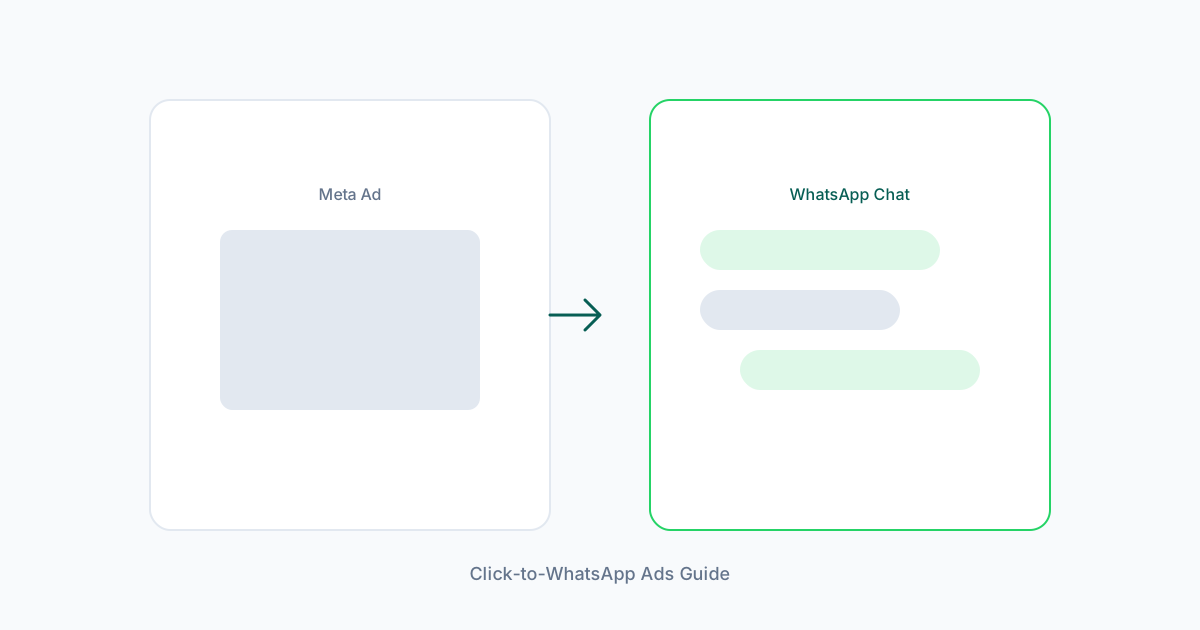
If you’ve already read our introductory CTWA guide, you know what Click-to-WhatsApp ads are and why they work for Indian businesses. This guide picks up from there: how to optimize a CTWA campaign that’s already running, what’s changed in 2026, and where the highest-leverage levers actually sit.
What’s changed in CTWA for 2026
Three meaningful shifts since the original guide:
- Meta’s auto-conversation-tracking is stable now. As of Q1 2026, Meta surfaces “conversations started” as a first-class metric in Ads Manager for CTWA campaigns. You no longer have to stitch BSP attribution and Ads Manager spend manually — though you should still cross-check.
- Advantage+ creative is mature for WhatsApp destination. Meta’s automatic creative variations now generate decent CTWA-friendly variants. Worth testing alongside manual creatives.
- Per-conversation pricing rose slightly in February 2026. Marketing conversation rates in India moved up ~6–8%. Utility unchanged. Build your unit economics on current Meta pricing, not numbers from a year ago.
Before you optimize: get the basics right
Most “underperforming” CTWA campaigns aren’t actually underperforming — they’re being judged against the wrong metric or built on a shaky foundation. Before optimizing, confirm:
- Your BSP captures the source campaign on every incoming conversation. Without source tagging, you’re optimizing blind. In Flowgento, this happens automatically on CTWA-originated conversations.
- Your team responds within 60 seconds during peak hours. Median response time is the single largest predictor of conversion. Bad response time wastes ad spend faster than any creative mistake.
- You have a baseline period of at least 7 days, 100+ conversations. Optimization decisions on less data are guesses.
- You’re measuring conversation-to-customer conversion, not just clicks. A 0.5% click-to-customer rate with a ₹10 CPM is far better than a 3% click-to-conversation rate with a ₹50 CPM and a 5% conversation-to-customer rate.
Creative optimization (the biggest lever)
Creative typically accounts for 60–70% of CTWA performance variance in our customer data. Targeting and bidding split the rest.
What works in Indian CTWA creative (2026)
- Static images outperform video for utility-style CTAs. Counter-intuitive, but the data is consistent: video over-promises and gets clicks from disinterested viewers. Photos of the actual product + a direct headline win.
- Hindi/Hinglish copy lifts CTR 30–50% in Tier-2/3 audiences. Test by region, not just by language. Hindi works for North/Central; consider Tamil/Telugu/Marathi/Bengali for regional campaigns.
- Single product, single benefit. Carousels work for brand awareness; static-image-one-product wins for conversation-cost.
- Visible price + UTM-style “Pay in EMI” hooks lift D2C conversions when AOV is ₹2,000+.
- Real-people creatives (founder talking, customer using product) beat stock photography by ~2× on engagement.
Iteration cadence
Don’t agonize over individual creatives. Ship in batches, kill fast.
| Stage | Creatives | Budget split | Decision window |
|---|---|---|---|
| Discovery | 6–10 variants | Equal split | 3 days |
| Refinement | Top 3 winners | 60/25/15 | 5 days |
| Scale | Top 1–2 + iterations | Variable | Ongoing |
A new winning creative typically lasts 4–8 weeks before audience fatigue. Plan for continuous iteration, not “one perfect creative.”
Audience targeting and lookalike scaffolding
CTWA targeting in 2026 benefits from a layered approach. Don’t bet a campaign on a single audience.
The 4-layer audience stack
- Custom audience: WhatsApp openers (last 90 days). Your warmest CTWA-specific audience — uploaded from your BSP. Highest conversion, lowest scale.
- Custom audience: website visitors / past customers (last 180 days). Strong fit when seeded from existing customer phone numbers.
- Lookalike from converted CTWA leads (1–3%). Once you have 1,000+ converted leads from CTWA, build a lookalike. This usually becomes your scaling workhorse.
- Interest + broad (Advantage+). Discovery channel for new audiences. Lower conversion, higher scale.
Budget allocation we see work well: 20% / 20% / 40% / 20%. Adjust based on which layer is delivering at acceptable CAC.
Geographic and demographic specificity
For Indian SMBs, going broader on geography but tighter on age/income often outperforms the inverse. A campaign targeting “all India, age 25–45, urban” usually beats one targeting “Mumbai only, age 18–55.”
Bid strategy and budget allocation
Bid strategy for CTWA in India in 2026:
- Cost cap is usually the best starting point if you know your acceptable cost-per-conversation. Set it 10–15% above your historical CPL.
- Lowest cost (volume) is good for discovery and during ramp-up — usually for the first 2 weeks of a campaign.
- Highest value rarely applies cleanly to CTWA because conversion value is post-conversation.
Budget allocation:
- Start with CBO (Campaign Budget Optimization) with 3–5 ad sets representing distinct audience layers. Let Meta allocate.
- After 7 days, if one ad set is starving while another dominates, switch to ABO (Ad Set Budget Optimization) and manually allocate.
- For brands spending ₹50,000+/month on CTWA, run a separate “always-on” campaign for warm audiences and a “discovery” campaign for cold — different bid strategies, different creatives.
Response-side optimization (the hidden lever)
This is the lever most CTWA optimization advice ignores, and it’s often where Indian SMBs leave the most ROI on the table.
Speed-to-first-response
For CTWA-originated conversations in India:
- < 2 minutes: ~30% conversion to qualified lead
- 2–10 minutes: ~20%
- 10–60 minutes: ~12%
- 1–6 hours: ~6%
- 6+ hours: ~3%
The drop is brutal. Most Indian SMBs we see have median response times of 45 minutes during business hours and “next morning” after-hours. If you’re spending ₹50,000/month on CTWA and your median response is 45 minutes, fixing response time alone will roughly double your conversion.
What “good” response looks like
- Automated greeting within 30 seconds. Confirm the customer reached the right place, set expectations on response time.
- Human or AI follow-up within 5 minutes during business hours. Ideally 60 seconds.
- Off-hours auto-response with a clear callback window. “We’ll reply at 9am IST tomorrow.”
In Flowgento, set up CTWA-source auto-replies that differ from organic auto-replies — CTWA conversations need faster, more sales-oriented opening lines.
Conversion-pattern optimization
Once you respond, what you say matters. CTWA conversations have a different anatomy than organic inquiries:
- First message: confirm context.
Hi {{name}}, you reached us about our {{product}} ad?— anchors the conversation to the ad they clicked. - Second message: qualifying question. Not “how can I help” — a specific qualifier (“Are you looking for office use or home?”, “What’s your typical budget range?”).
- Third+ message: route to closer. Don’t drag inquiries through 10+ messages with one agent.
Track the average message-count-to-conversion for your CTWA conversations. Shortening this from 8 to 5 messages typically lifts conversion 20%+.
Attribution windows and how to read the data
Meta defaults CTWA campaigns to a 7-day click attribution window. That’s usually too short for Indian SMB conversion patterns. Adjust to 28-day click for products with longer consideration cycles (real estate, education, expensive D2C).
What metrics to actually watch
Ignore CTR and CPM. The ones that matter:
- Cost per conversation started — Meta-reported, available in Ads Manager.
- Cost per qualified lead — your BSP/CRM-reported, after your team has qualified the conversation.
- Cost per customer — final conversion cost, including any closing time.
- CAC payback — for subscription or repeat-purchase models, how many months until LTV covers CAC.
For most Indian SMBs, a CAC payback under 3 months on CTWA is considered very healthy.
Why Ads Manager numbers and BSP numbers differ
You’ll often see different “conversations” counts between Ads Manager and your BSP. Reasons:
- Some users click the ad, see WhatsApp open, but don’t send the prefilled message. Ads Manager may count the click; BSP doesn’t see a conversation.
- Multiple clicks from the same user in a session: Ads Manager dedupes; BSP sees one conversation.
- Block-list users: BSP filters; Ads Manager doesn’t.
Use BSP numbers (Flowgento, or whichever) for actual conversion math. Use Ads Manager for relative optimization (which ad set, which creative).
Cost benchmarks (India, May 2026)
Take ranges, not point figures — performance varies by industry, AOV, and brand maturity.
| Metric | D2C | Real estate | Edtech | Healthcare/clinics |
|---|---|---|---|---|
| Cost per click | ₹3–8 | ₹8–25 | ₹6–15 | ₹5–12 |
| Cost per conversation | ₹15–50 | ₹80–250 | ₹40–120 | ₹25–80 |
| Conversation → lead | 30–55% | 25–40% | 35–55% | 40–60% |
| Lead → customer | 8–20% | 3–8% | 6–15% | 25–45% |
| Effective CAC | ₹300–1500 | ₹3000–25000 | ₹500–4000 | ₹150–900 |
If your numbers are 2× worse than the ranges above, optimize before scaling spend. If they’re 2× better, scale carefully — most “incredible” CTWA results don’t survive 3× budget increases.
How to scale without breaking economics
The pattern that works for Indian SMBs scaling from ₹50k → ₹500k/month CTWA spend:
- Stabilize first. Don’t scale until you have 4 consecutive weeks at acceptable CAC.
- Lift budgets by 20–30% per week, not 100% overnight. Meta’s optimization needs time to find your incremental audience.
- Add audiences before adding creatives. A lookalike-2% before changing creative usually outperforms.
- Diversify ad accounts at very high spend (₹300k+/mo) to avoid platform-wide auction concentration.
- Hire response capacity before scaling. A doubled budget with the same response team usually halves conversion rate.
Common mistakes that kill CTWA performance
- Optimizing on cost per click. CPC tells you nothing about CTWA. Optimize on conversation-cost minimum, and qualified-lead-cost when possible.
- Running the same creative for >8 weeks. Indian Meta audiences fatigue fast. Refresh creative continuously.
- Treating CTWA conversations like website leads. Different funnel, different objection set, different close timing.
- Sending CTWA leads into broadcast lists. CTWA conversations are warm and human; pushing them into bulk marketing kills both ad quality score and conversion.
- Optimizing the ad and ignoring the conversation script. The biggest unlocks usually live in what your team says in the first 3 messages.
FAQs
Does Advantage+ Shopping work for CTWA destinations? Yes, but the recommendations target purchase events. For CTWA, use “Sales” or “Leads” objective with WhatsApp destination — those Advantage+ flavors optimize correctly.
Should I run CTWA across both Facebook and Instagram? For most Indian SMBs, Instagram CPMs are higher but engagement quality is also higher. Start with both, then split-test by 2 weeks to see which channel performs better for your category — categorical results vary.
Can I track CTWA conversions in Google Analytics? Indirectly. Conversions land in your BSP. Push them back to your CRM, then into GA via Measurement Protocol. Most Indian SMBs we work with stop at BSP-level conversion tracking — it’s where the most actionable data lives.
Is there a quality score for CTWA specifically? Yes — your WhatsApp Business phone number’s quality rating affects what Meta charges per conversation and whether your messages get the green-tick. Bad CTWA experience (slow response, spammy follow-up) hurts quality score and inflates ad costs in a feedback loop.
How do I A/B test CTWA creatives? Standard Meta A/B test framework works. Test creative-only first (same audience, same bid), then audience, then bid strategy. Don’t test all three at once — you can’t attribute the lift.
Try Flowgento free
The WhatsApp CRM built for Indian SMBs. No credit card, no broker markup.